I am a fan of conclusions up front. You should not have to read to the end of an article to find out whether I think a piece of equipment is worth trusting.
The KT-Mech Akela is not fit for duty use.
The holster is bulky, the ordering process is needlessly complicated, and mine repeatedly tried to disassemble itself because none of the screws came with threadlocker. Those problems were aggravating, but they could at least be corrected.
The problem that could not be corrected was the retention system. During a fight, my body armor disengaged it and my pistol began sliding out of the holster. I caught the gun before it hit the ground—or, worse, became part of the fight.
That was the end of the Akela for me.
The rest of this review explains why I ever thought it might be good enough.
Why I Bought It
I bought the Akela because I wanted to carry an FNX-45 Tactical on duty, and holster support for that pistol was terrible.
That remains one of the great practical limitations of otherwise excellent handguns. A pistol can be reliable, accurate, and pleasant to shoot, but if nobody makes serious duty gear for it, it is not really a duty pistol.
Safariland supports the guns most police officers carry. If you have a Glock or an M&P, there is little reason to look elsewhere. If you insist on carrying something less common, however, you may find yourself wandering into the stranger corners of the holster market.
That is how I found KT-Mech.
What KT-Mech Got Right
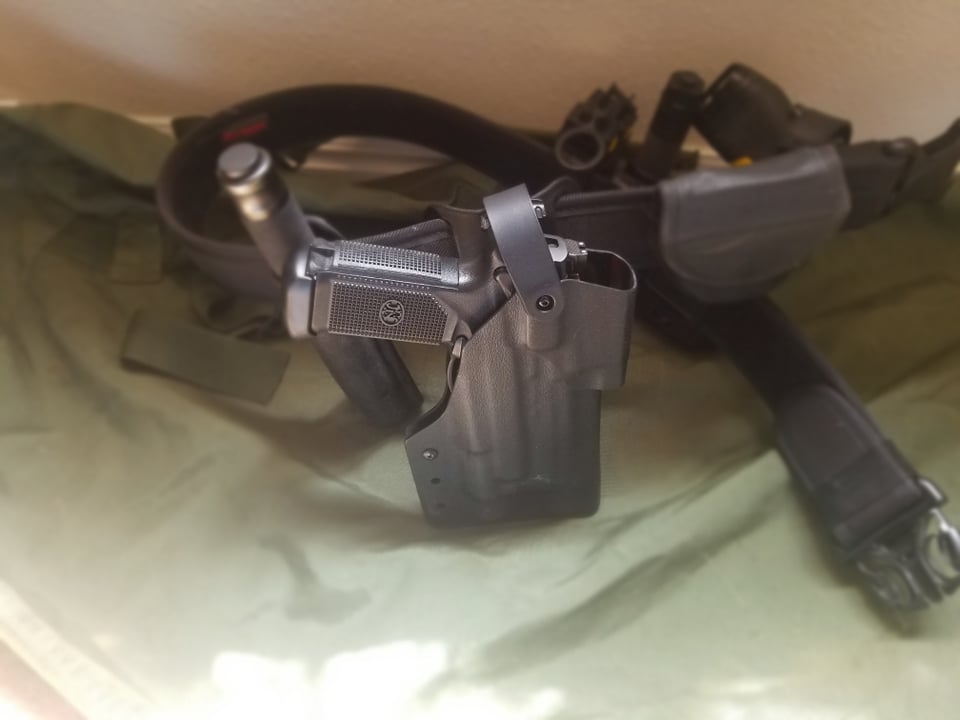
The holster was manufactured and shipped quickly. It was made from thick material and felt sturdy. Once I worked through the initial problems, it functioned reasonably well in controlled practice.
I was initially concerned that the spring-loaded, ALS-style retention hood would slow my draw. It did not. I even tried to cheat the system by pulling against the gun before releasing the retention, and I still could not beat the spring. Once activated, the mechanism got out of the way quickly.
The release itself is a large button on the side of the holster. Instead of pressing down with the thumb, you push it sideways. It is not intuitive at first, but with enough practice it becomes second nature.
I did notice that my body armor would occasionally press the button and release the retention. The mechanism made a distinct click when that happened, and during normal activity I was always able to hear it and reengage the hood.
At the time, I convinced myself that was manageable.
That judgment did not age well.
The French Fry Funnel
The Akela is enormous. It occupies far more space on a duty belt than its function should require, and some creative engineering could have shaved inches from the overall package.
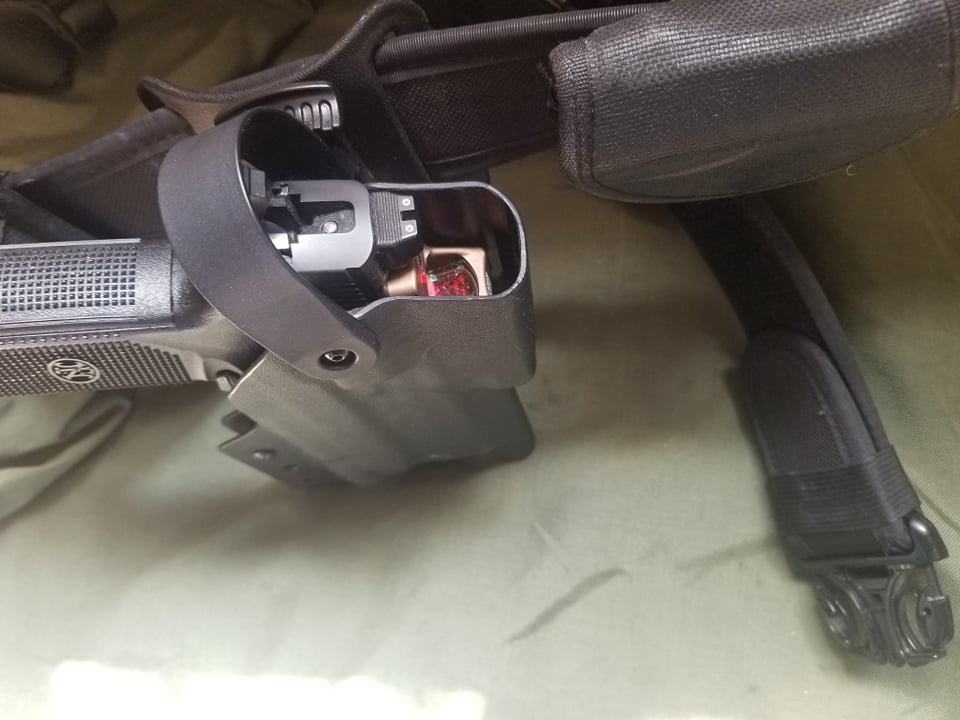
The optic housing made the problem worse. It surrounded the optic but did not have a cover over the top. Snow, sand, or French fries could fall into the housing and block the optic.
Let’s be honest: French fries are the most likely scenario.
Ordering Like It Is 2003
KT-Mech’s website looked like something a middle-school student built on AngelFire in the early 2000s. The black background and neon text made the company look disreputable enough that I probably would not have ordered from it if I had not already seen forum and Facebook posts from people who appeared to have received real holsters.
The site also did not offer a normal way to select the optic housing or the liner intended to protect the pistol’s finish. Those options had to be requested by email and paid for through a second invoice after the holster itself had already been purchased.
I ordered and paid for both. My holster arrived with the optic housing but without the liner.
That was fine. It merely meant I would not have to throw the FNX down the driveway to achieve the battle-worn finish we all know and love.
The Screws Start Leaving
After some dry fire and only my second range session with the Akela, two of the three screws securing the holster to my belt worked loose and disappeared into the desert.
I did not notice immediately. I holstered the FNX and watched in horror as the entire holster swung on its one remaining screw and dumped the pistol onto the ground.
That was frustrating for me. It could have been deadly for the owner of a SIG P320.
I put my Safariland ALS holster back on my belt and used it until I could get replacement hardware.
When I contacted KT-Mech, the company referred me to an email explaining that the screws were shipped without Loctite. Technically, the warning was there. It was buried in the final paragraph of a wall of text sent during the ordering process, but it was there.
KT-Mech charged me $10 after shipping for three replacement screws. Ten dollars is not a meaningful amount of money in the grand scheme of things. It was still irritating knowing that, with the thread size and length, I could have replaced them locally for pennies.
The explanation for leaving the screws without threadlocker was that customers often change mounting systems. They may add a Safariland QLS fork or a Blackhawk quick-disconnect system, so KT-Mech leaves the mounting hardware easy to rearrange.
I understand the logic. I do not agree with it.
Blue Loctite would keep the holster assembled while still allowing an owner to change the mounting system later. Shipping a duty holster with unsecured fasteners and burying the warning in an email is not a reasonable substitute.
Still, I installed the new screws, applied blue Loctite, and thought I was ready to put the issue behind me.
A day or two later, I rested my hand on the pistol and noticed that it was remarkably loose. This time, the screws holding the body of the holster together had backed out and disappeared.
These were not the mounting screws a customer might remove to install a different belt attachment. These were the screws holding the holster itself together. I recovered one of the two, reinstalled it with blue Loctite, and the holster seemed to hold.
By that point, the lesson was obvious: if you own an Akela, apply blue Loctite to every screw on it before you put a loaded pistol anywhere near the thing.
The Failure That Ended It
For a while, I thought I had solved the problem. The hardware was secured, I had trained enough with the sideways release to use it reliably, and the holster retained the FNX as long as the active-retention hood remained engaged.
That last qualification mattered more than I understood.
Once the button was pressed and the hood released, there was very little friction between the holster and the pistol. The gun did not remain seated with useful passive retention. It simply slid out.
I already knew my body armor could press the release. On the range or while standing around, the click was obvious and I could correct it. During a physical fight, with my attention and body being pulled in several directions, my vest disengaged the retention and the gun began working its way out of the holster.
Fortunately, I felt it moving and stopped it before it fell to the ground and was introduced into the fight.
There was no need for further testing. A duty holster gets exactly one opportunity to fail that way.
I removed the Akela and ultimately changed weapon systems because I could not obtain safe, reliable duty gear for the FNX-45 Tactical.
Final Verdict
KT-Mech did a few things right. The holster arrived quickly. The shell was sturdy. The spring-loaded hood was fast enough that it did not slow my draw.
None of that outweighs the failures.
The website was bad and the customer service was worse, but neither is why I stopped using the holster.
The Akela repeatedly shed unsecured hardware. Its retention release could be activated by the body armor worn directly beside it. Once that retention was defeated, the pistol could slide out with almost no resistance. Any one of those issues would concern me. Together, they make the holster unacceptable for duty use.
If you own a common pistol, buy the Safariland and move on with your life.
If you own something unusual and KT-Mech is one of your only options, the Akela may be adequate for controlled range use after every screw has been treated with blue Loctite and the hardware has been carefully inspected. I would not trust it on duty.
Sometimes the absence of a good holster is the answer. It means the gun you like is not a viable duty weapon, no matter how well it shoots.
The Akela was not good. More importantly, it was not good enough.
---
*An earlier version of this review originally appeared at Live Red E. My thanks to Dave for publishing it and giving the original piece a home.*
Published after editorial review
Last revised 9/11/2026. Evidence and limitations should be interpreted as described in the article.
Discussion
Comments are moderated before appearing here. Keep it useful, specific, and civil.
No approved comments yet. Be the first to add something useful.