1. Why I Bought the Ethos
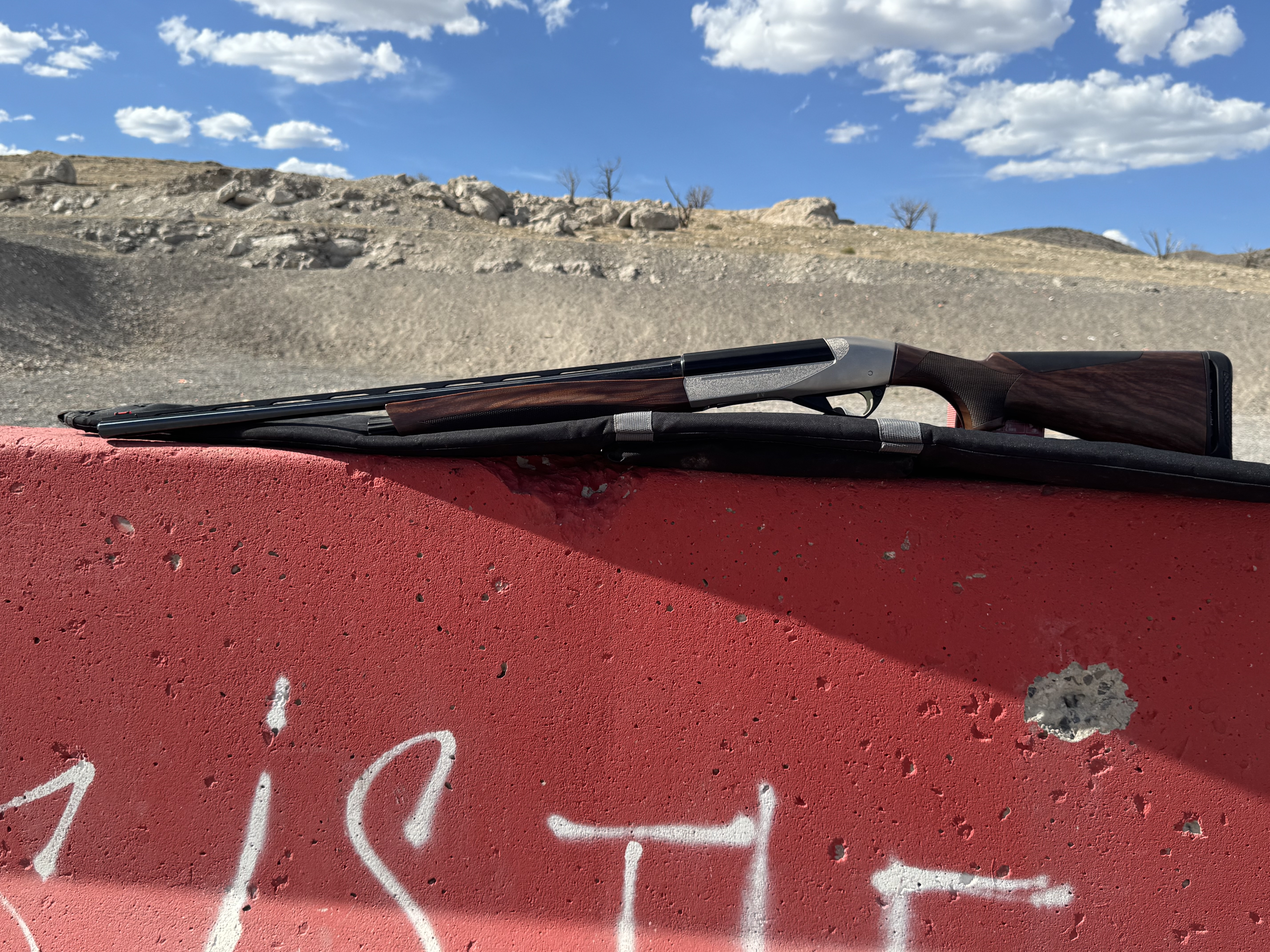
My Franchi met an untimely demise early last hunting season, and I suddenly found myself without a dedicated upland gun. I spent the rest of the season hunting behind my Beretta A300, which is an excellent shotgun, but it's a little heavy for long days in the chukar hills.
The Benelli Ethos had everything I wanted on paper: 4+1 capacity, light weight, and the opportunity to finally try hunting with a 20 gauge.
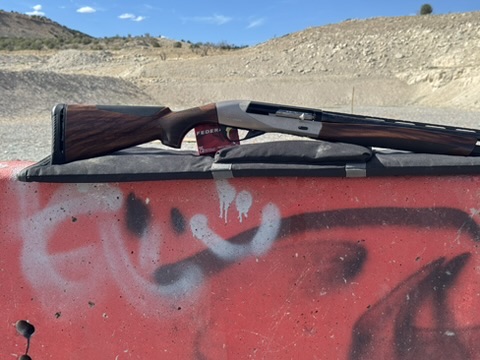
Not only that, the gun is beautiful. The wood is nice, and the black and silver look excellent alongside it. I already know I'm going to be sad the first time I slip on some lava rocks and ding it up.
I haven't killed any birds with this gun yet, but I've put about 500 rounds through it on clay targets, and so far my impression has been quite favorable.
2. First Impressions
The first thing I noticed about the Ethos was how soft it shoots. A lightweight inertia gun isn't necessarily what I would expect to be a soft shooter, especially coming from a gas-operated Beretta A300, but the Ethos has been surprisingly pleasant. Even after a long afternoon shooting clays, recoil has never been something I've thought much about.
The action is also ridiculously smooth. Everything about it feels polished. The bolt runs like it's on ball bearings, and after roughly 500 rounds, the gun has cycled without giving me anything to complain about. Loading, unloading, and working the action all have that slick, almost effortless feel you expect from an expensive shotgun.
More importantly, the gun points naturally. At just over five pounds, it comes to the shoulder quickly and moves extremely well between targets. It feels lively without feeling uncontrollable, which is exactly what I was hoping for in a gun that will eventually spend its days being carried up and down chukar hills.
There was a little bit of an adjustment period. The Ethos didn't give me exactly the same sight picture I was accustomed to with my other shotguns. I found that I needed to float some targets slightly rather than covering them completely with the barrel. Once I figured that out, my shooting settled in pretty quickly.
And then there is the obvious part: the gun is gorgeous. The walnut, black receiver, and silver accents make the Ethos look much more like a traditional upland gun than most modern semi-autos. That doesn't make it shoot any better, but when you're spending this much money on a shotgun, there's nothing wrong with enjoying the way it looks.
Light, fast, surprisingly soft-shooting, and completely reliable so far.
3. Why a 20-Gauge Semiauto for Upland?
You may be asking why I moved from a 12 gauge to a 20 gauge. Mostly, it was about weight. The Ethos gives me a significantly lighter gun than the 12-gauge Beretta I hunted with last season, and ounces start to matter after a few hours in chukar country.
And you know what? A #6 pellet is the same size whether it comes out of a 20 gauge or a 12 gauge. Typical hunting loads are also moving at similar velocities. The main difference is payload: a 20-gauge shell generally puts fewer pellets in the air.
That means less pattern density and a little less margin for error, but a 20 gauge is still plenty of gun for anything I'm likely to encounter in the uplands.
My go-to 12-gauge load has been #7½ shot through an Improved Cylinder choke. I've found it to be absolutely deadly on close-flushing, fast-moving birds like chukar. I keep some #6s on me in case I run into tougher shooting conditions, but I almost never use them.
My plan is to start with essentially the same philosophy in the 20 gauge and see how it performs in the field.
A #6 pellet is still a #6 pellet. The 20 gauge gives up pellet count, not pellet size.
4. How It Actually Shoots
The Ethos is a very fast-shooting gun. Coming from my Beretta, though, I immediately noticed that the two guns did not put the pattern in exactly the same place relative to what I was seeing. For the first few outings, that required some adjustment. It wasn't a problem with the gun so much as learning the mechanics of a different shotgun.
I don't like consciously thinking about point of aim when I'm shooting a shotgun. In fact, I try very hard not to. I want my eyes on the target, not the bead. My approach is to practice the same mount over and over until the gun comes to the same place naturally, then let my subconscious handle the lead and alignment.
After several hundred rounds, that is starting to happen with the Ethos. I see the target, mount the gun, and shoot.
That is where the light weight of the Ethos really shines. It is exceptionally quick to get moving and equally quick to change direction. On crossing targets, I can get the muzzle onto the target with very little effort and maintain the swing without feeling like I'm dragging the gun behind me. On going-away targets, the gun comes up so quickly that there is very little delay between identifying the target and breaking the shot.
I was initially concerned that such a light shotgun might feel whippy. So far, I haven't found that to be the case. It is certainly livelier than a heavier sporting gun, and it will move exactly as much as you tell it to, but once I became accustomed to it, I stopped feeling like I needed to consciously control the barrels. It simply follows my eyes.
Muzzle rise is also minimal enough that the gun recovers very quickly. On doubles, I don't feel like I'm waiting for the gun to settle before moving to the second target.
At this point, I wouldn't say that I shoot the Ethos dramatically better than my previous guns. I would say that I shoot it faster. The Beretta and I had years of familiarity behind us, while the Benelli is still relatively new.
After roughly 500 rounds, however, the Ethos is reaching the point where I am no longer consciously operating it. The gun is beginning to disappear between me and the target.
For an upland shotgun, that may be the highest compliment I can give it.
5. Fit, Controls, and Everyday Handling
The manual of arms was unfamiliar to me at first, particularly coming from the Beretta, but it took about two minutes to figure out. Once I did, everything about operating the Ethos felt straightforward.
The controls are easy to reach and operate smoothly. The oversized charging handle is particularly nice. It is large enough to find immediately and gives you plenty to grab when cycling the action. Loading and operating the gun quickly became second nature.
The stock also fits me exceptionally well. Benelli includes shims to adjust drop and cast, but I haven't needed them. Out of the box, the gun comes naturally to my shoulder and puts my head where it needs to be. Considering how much shotgun shooting depends on a repeatable mount, having the stock fit correctly without any adjustment has been a significant advantage.
My one complaint is the safety.
The Ethos places the safety behind the trigger guard. There is nothing inherently wrong with the design, and it is easy enough to operate, but after years with my Beretta, I strongly prefer a safety positioned at the front of the trigger guard. That location feels more natural to me when mounting the gun and preparing to shoot.
I'm sure repetition will make the Benelli's safety location automatic eventually, but after several hundred rounds, it remains the one control I would change if I could.
Otherwise, the Ethos has been remarkably easy to live with. The controls are simple, the action is smooth, and the gun fits me without modification. Nothing about operating it gets in the way of shooting it.
6. Chokes and Loads I'm Planning to Hunt With
Grouse season is less than two weeks away, and I can't wait to take the new gun out.
My plan right now is to hunt with Federal High Brass #7½ shot through an Improved Cylinder choke. If money were no object, I'd probably be shooting BOSS copper, but I've got a quinceañera to save for, so bulk premium ammunition isn't happening anytime soon.
For now, these are my planned loadouts for the upcoming season:
* Chukar: Improved Cylinder / #7½
* Dusky and ruffed grouse: Improved Cylinder / #7½
* Huns: Improved Cylinder / #7½
* Pheasant: Improved Cylinder / #5 or #6
* Ducks, when appropriate: Carlson's extended-range choke / #4 steel—or, ideally, a smaller copper shot size if I scrape enough pennies together
Five hundred rounds of clay shooting have told me quite a bit about the Ethos. I know how it fits me. I know how it shoots. I know it has been reliable, and I know I enjoy carrying and operating it.
What I don't know yet is the part that actually matters most: how it performs when the targets have feathers.
Published after editorial review
Last revised 9/11/2026. Evidence and limitations should be interpreted as described in the article.
Discussion
Comments are moderated before appearing here. Keep it useful, specific, and civil.
No approved comments yet. Be the first to add something useful.